
Why this matters
Data-center infrastructure is increasingly a system problem rather than a collection of independent components. Rack power density is rising and heat is concentrated into smaller physical volumes. This changes the way engineers evaluate a platform: a decision that looks small at component level can affect signal margin, airflow, serviceability and qualification effort elsewhere. Air cooling remains effective in many systems, but its limits depend on inlet temperature, pressure, heatsink geometry and fan power. For European enterprise and AI projects, the practical question is therefore not simply which technology is newest, but which architecture can be deployed, maintained and upgraded reliably.
System design implications
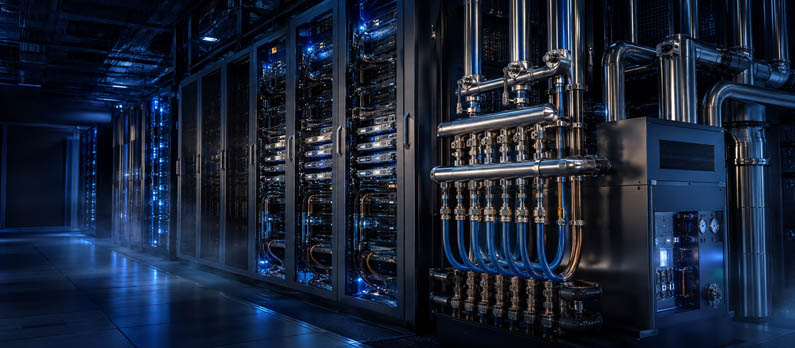
Liquid cold plates move heat closer to the source and can reduce dependence on very high airflow. That is why mechanical layout and electrical design need to be reviewed together. Mechanical fit, hose routing, leak strategy, materials and serviceability are as important as nominal thermal capacity. A robust project normally starts with the actual server geometry, target performance, expected cable path, cooling environment and service concept. Specifications on a datasheet are useful, but they do not replace validation in the complete channel or thermal system.
Engineering priorities
Hybrid architectures can use air for memory and auxiliary components while liquid cooling handles CPUs or accelerators. In practice, modularity can be valuable because it allows selected parts of a platform to evolve without forcing a complete redesign. Engineers should also leave realistic margin for manufacturing tolerances, connector variation, temperature and future platform revisions. The objective is not maximum complexity; it is predictable operation with enough headroom for the intended application.
What to expect next
Thermal design should start from the actual platform and workload instead of selecting a cooler from TDP alone. Over the next product generations, density and bandwidth will continue to rise. This will make cross-disciplinary coordination more important: thermal, mechanical, signal-integrity and procurement teams will need to make decisions earlier and with better shared data. For customers, the most useful solution will often be the one that reduces integration risk while remaining serviceable over the life of the system.
From specification to deployment
A useful technical specification should describe more than the headline interface or performance number. It should identify the operating environment, mechanical envelope, expected airflow or coolant conditions, cable routing constraints, connector cycles, service access and the validation target. This is especially important in customized server hardware, where a component may work perfectly on a bench but behave differently after it is installed beside high-power CPUs, GPUs, memory, power supplies and dense cable bundles. Early coordination reduces the number of late mechanical changes and helps keep qualification focused on measurable risks.
For procurement, this also creates a clearer basis for comparing alternatives. Instead of comparing only unit price, teams can evaluate integration effort, expected lifetime, replacement strategy and the cost of future platform changes. In fast-moving AI infrastructure, those factors can be more important than a small difference in component cost.